
 Tiếng Việt
 Japanese
 Chinese
 Korean

ACAC STANDS WITH THE COMMUNITY
When the Blue Sky Begins with the Data: The ESG Journey of Small and Medium Enterprises
From Compliance to Strategy: The ESG Journey for SMEs
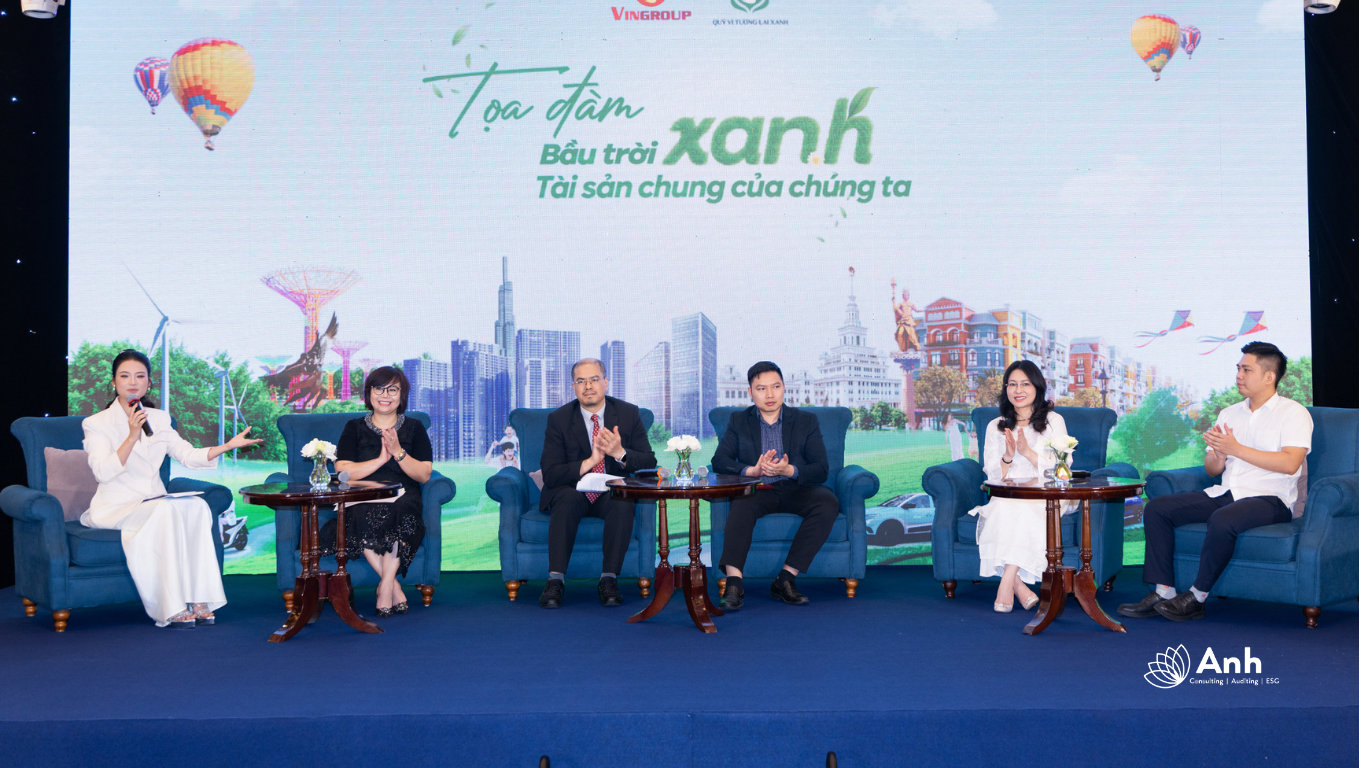
On 9 September 2026, at the Almaz Conference Center (Hanoi), the specialized seminar “Blue Sky: Our Shared Asset” brought together representatives of the Foundation for a Green Future, the Ministry of Education and Training, the Ministry of Agriculture and Environment, experts from Vinmec and VinUni, the “Green Hanoi” volunteer community, together with numerous enterprises, youth organizations, and students. In the program’s “Practical Sharing” session, Ms. Nguyễn Thị Mai Anh – Chairwoman of the Members’ Council cum General Director of Công ty TNHH Tư vấn và Kiểm toán Anh (Anh Consulting and Auditing Co., Ltd. – ACAC) – was the sole business representative invited to present, on the topic: “From Compliance to Strategy: How Should Small and Medium Enterprises Begin Their ESG Journey?”
With nearly 30 years of experience in auditing, tax advisory, finance, M&A, and green transition consulting for multinational corporations and FDI enterprises, Ms. Mai Anh brought to the seminar a practical perspective: ESG is not a matter reserved for large corporations, but a journey that every small and medium-sized enterprise (SME) can – and should – begin today.
Pressure Is No Longer a Matter for the Future
Opening her presentation, Ms. Mai Anh identified three milestones demonstrating that environmental requirements have shifted from encouragement to obligation, across all three fronts: export markets, the domestic legal framework, and capital markets. As of 1 January 2026, the European Union’s Carbon Border Adjustment Mechanism (CBAM) has begun formally charging actual fees on goods exported to the EU that carry embedded emissions. Domestically, under Decision No. 42/2026, 2,441 facilities are now listed among those required to conduct greenhouse gas inventories – no longer a voluntary option. In parallel, Decree No. 119/2025 paves the way for a domestic carbon market, establishing Vietnam’s first official trading venue for carbon credits.
“ESG Is a Cost” – The Most Common Mindset Trap
According to Ms. Mai Anh, the greatest barrier keeping SMEs hesitant about ESG is not a lack of resources, but a mindset: viewing ESG as an expenditure with no clear return, which always provides a reason to postpone it – “to be addressed once the company has grown larger.”
“ESG is a cost” – the phrase Ms. Mai Anh says she hears most often when advising businesses directly.
To challenge this mindset, she cited the example of a power sector enterprise that, with ACAC’s advisory support, shifted its thinking from “cost” to “investment”: from the same ESG foundation, this enterprise generated four parallel streams of return – revenue from emissions reduction, access to international green capital, contracts with global customers, and enhanced market reputation. On the first stream alone, the enterprise successfully sold nearly 700,000 Renewable Energy Certificates (RECs), equivalent to more than 3.5 million tonnes of CO₂ in recognized emissions reductions – while also becoming one of the first Vietnamese enterprises to obtain an internationally certified Green Finance Framework, opening the way to green bonds and preferential-rate green loans.
From this example, Ms. Mai Anh highlighted the difference between two mindsets: enterprises with a compliance mindset pursue ESG “to avoid penalties,” producing reports merely for the sake of it and passively waiting for requirements; enterprises with a strategic mindset pursue ESG “to gain competitive advantage,” using data to drive decisions and proactively lead the market. For the same initial investment, one side incurs a one-time expense, while the other reaps returns repeatedly.
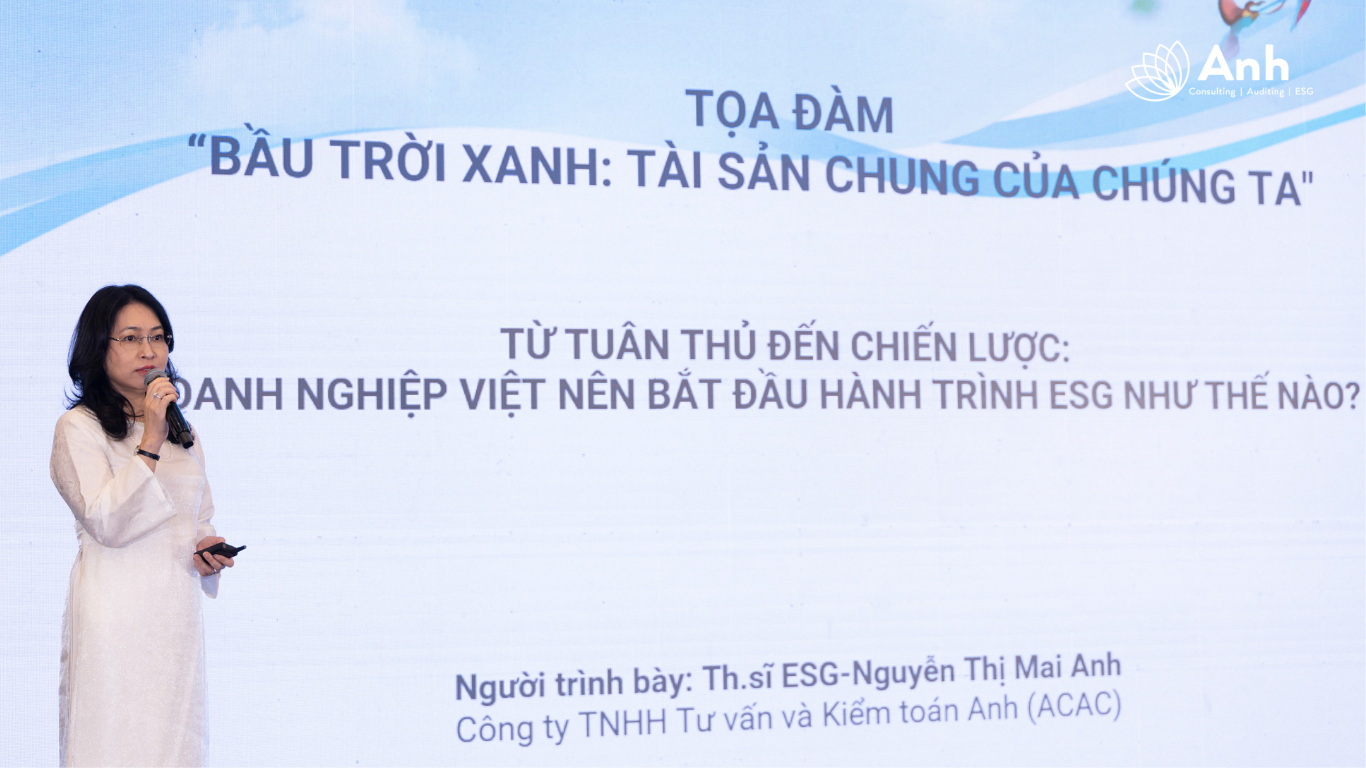
ACAC General Director Ms. Nguyễn Thị Mai Anh speaking at the seminar “Blue Sky: Our Asset”
Four Common Mistakes SMEs Make When Approaching ESG
Drawing on her advisory experience, Ms. Mai Anh identified four mistakes that cause many ESG projects at small and medium-sized enterprises to fail to generate value, and in some cases to “die out” immediately after the consulting firm departs:
- Treating ESG as producing reports for appearance’s sake – a reactive exercise disconnected from any business value.
- Waiting until resources are “sufficient” to begin – when resources will never truly be sufficient, while market opportunities always come with a deadline.
- Spreading efforts too thinly without identifying materiality – touching on everything a little but going deep on nothing.
- Purchasing technology or engaging consultants before building internal understanding – leaving the investment un-“absorbed” and unsustained once the project ends.
A Three-Step Roadmap, No Major Investment Required
To enable SMEs to begin immediately without a large budget, Ms. Mai Anh proposed a three-step roadmap:
- Step 1 – Measure (0–3 months): Conduct a rapid inventory of three basic streams – electricity, fuel, and waste – requiring no expensive software, only accurate data. “What can be measured can be managed.”
- Step 2 – Prioritize (3–6 months): Identify the 2–3 issues most material to your industry, going deep on a few priorities rather than spreading efforts thin across everything.
- Step 3 – Elevate (6–12 months): Turn actions into an evidence-based narrative – to support fundraising, retain customers, and build brand equity.
She noted that this same enterprise began with exactly such basic steps years before becoming the ESG model honored at the Vietnam ESG Award 2025 – demonstrating that this is a path any enterprise, not only large ones, can follow, provided it begins the right way.
The Core Lesson: Technology and Capital Can Be Bought, but Capability Must Be Built
Closing her presentation, Ms. Mai Anh summarized three key points: external consultants can help launch an ESG system, but only the internal team can operate it day to day; the true value lies in people who understand ESG as an asset rather than a cost – a staff member who can read emissions data can unlock both green capital and new orders; and the cheapest yet highest-leverage investment across the entire journey is knowledge.
In this spirit, she introduced ACAC’s companion ecosystem of services for Vietnamese enterprises: the Chief Sustainability Officer (CSO) training program, which equips enterprises’ internal teams with ESG capabilities directly – from foundational knowledge to the ability to prepare reports compliant with international standards, audit-ready and carbon-audit-ready; alongside advisory services for Emissions Trading Scheme (ETS) compliance, carbon portfolio development and management, and end-to-end carbon auditing – from greenhouse gas inventories through to ESG reporting ready for green capital access and export markets.
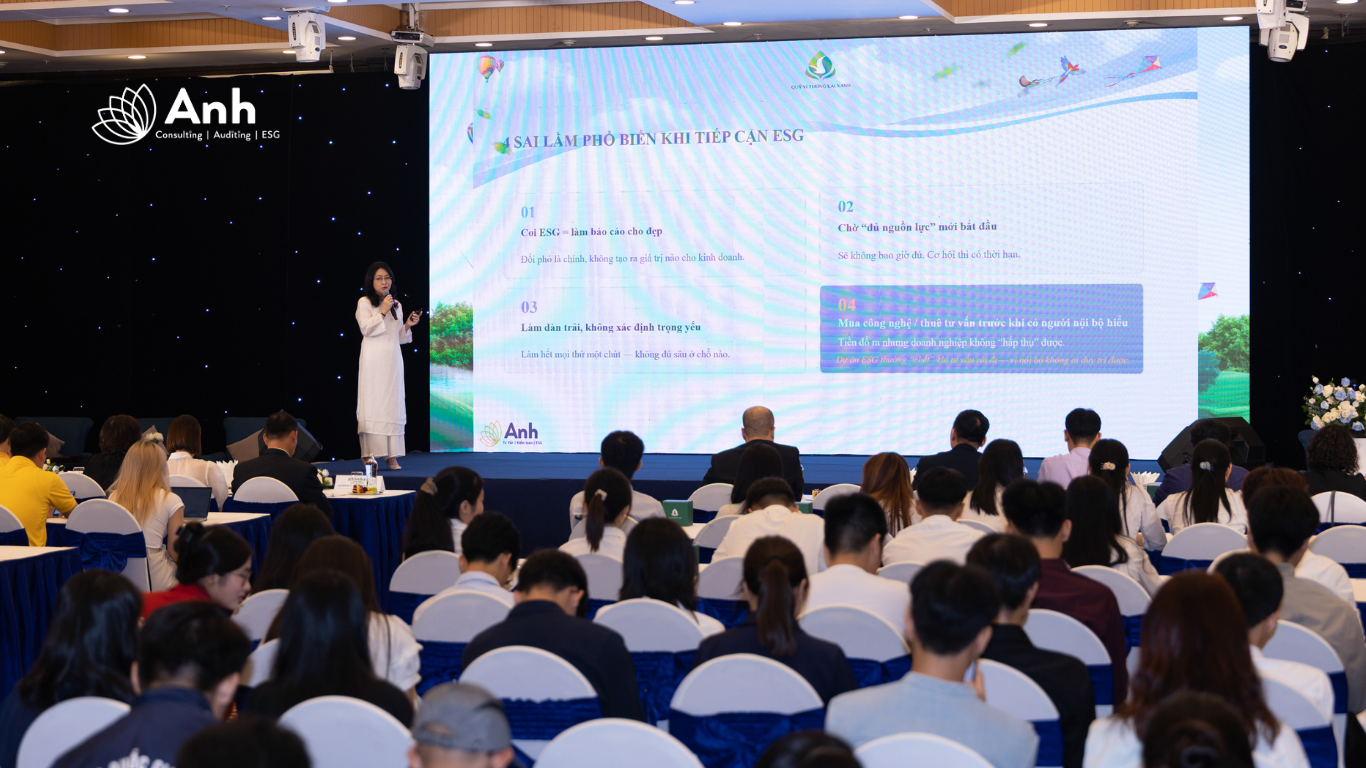
“We do not do it for you – we walk alongside you so that you can do it yourself.” – Nguyễn Thị Mai Anh, General Director of ACAC
Closing Remarks
The message running throughout Ms. Nguyễn Thị Mai Anh’s presentation at the seminar was a clear affirmation: the ESG journey of small and medium enterprises does not begin with an expenditure, but with an investment decision – and that decision requires neither sufficient resources nor large scale, only the right sequence: measure first, prioritize correctly, then elevate through concrete evidence.
For ACAC, accompanying enterprises through each step of that journey – from internal capability building to implementation advisory – is how a blue sky ceases to be merely a shared aspiration and becomes a concrete investment that every enterprise can begin today.
Contact ACAC for advisory on an ESG roadmap tailored to your industry and enterprise scale.