

 Tiếng Việt
 Japanese
 Chinese
 Korean
Amid a wave of tax audits increasingly scrutinizing personnel costs outsourced from third-party providers, outsourced/leased labor in Vietnam has become a legal topic of particular concern to many FDI enterprises. Anh Auditing and Consulting Co., Ltd. (ACAC) organized a seminar for the leadership of enterprises belonging to the Korea Chamber of Commerce and Industry in Vietnam (KOCHAM), comprehensively addressing the legal and tax issues surrounding this model.
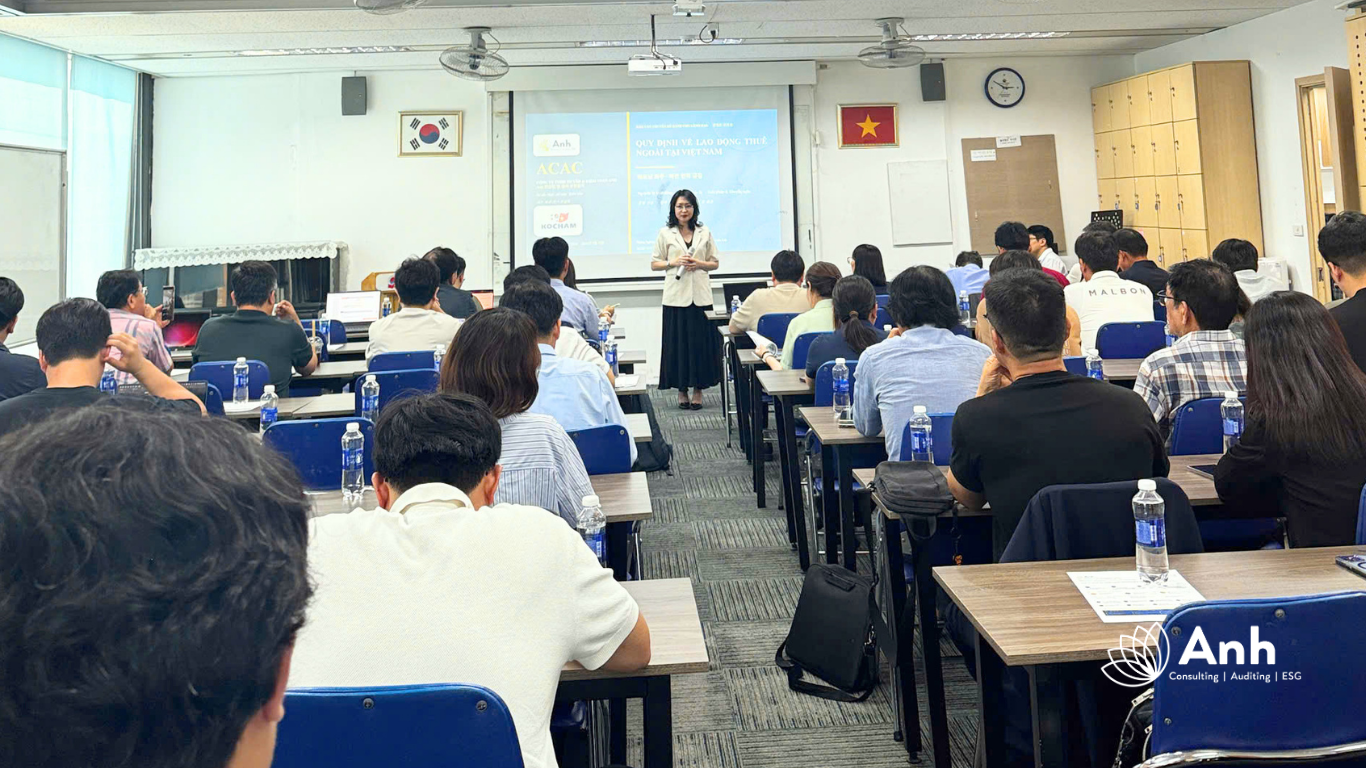
The seminar centered on a core message: outsourced labor costs are accepted by the tax authorities only when two conditions are satisfied at the same time – compliance with labor law and compliance with tax requirements – and ACAC structured the seminar into three main parts.
How Outsourced/Leased Labor Operates in Vietnam
Labor leasing is, by nature, a three-party relationship rather than an ordinary employment contract: the leasing company signs the labor contract, pays wages, and contributes social insurance, while the host company only directs the worker’s day-to-day tasks without signing an employment contract with the worker directly.
Key mandatory legal conditions enterprises need to understand:
- Labor leasing is only lawful within the 20 job categories listed in Appendix II of Decree 145/2020/NĐ-CP.
- The maximum leasing term is 12 months per worker.
- The leasing company must hold an operating license and post a deposit of VND 2 billion.
- From July 1, 2026, the management mechanism will shift from a licensing regime to a self-compliance-plus-notification regime under Resolution 66.18/2026, although the list of 20 job categories remains unchanged.
An important point enterprises must clearly distinguish is that “labor leasing” is different from “subcontracting/staffing services” — the two forms are treated differently for tax purposes, and confusing them is a common cause of risk during tax audits.
ACAC provides a detailed breakdown of the legal risks associated with outsourced/leased labor that enterprises may face:
- Contractual risks: using leased labor for job categories outside the permitted list, exceeding the 12-month term limit, missing mandatory contents required under Article 55 of the Labor Code, or engaging a labor-leasing provider that does not hold a valid license.
- Tax and social insurance risks: arising when the labor-leasing company fails to comply with its declaration and social insurance payment obligations for workers.
- Joint liability: the host company (the entity that leases the labor) remains liable for occupational safety, workplace accidents, unpaid wages, and social insurance arrears even though it has no direct employment contract with the leased workers.
- Corporate income tax (CIT) and VAT risks: the related expenses may be disallowed as deductible costs, and input VAT may be denied under the new conditions applicable from 2025.
- Administrative sanctions: administrative fines, license revocation, and back-tax assessments together with late-payment interest.
- Errors originating at the contract stage typically trigger both labor-law risk and tax risk simultaneously, with the highest exposure concentrated among manufacturing enterprises and long-term, high-value contracts.

Practical Solutions for Enterprises by Period
2020-2024 Period
Enterprises should review the actual scope of work performed, the payment structure, and the legal documentation of the labor-leasing provider, while preparing a documentation file that evidences the costs as genuine expenses incurred for production and business operations. ACAC’s professional view is that, since Decree 320/2025/ND-CP only took effect from 2025, there is no legal basis for retroactive application to prior periods; nevertheless, enterprises still need robust supporting documentation to proactively respond should the tax authorities raise questions.
From 2025 Onward
Recommendations include:
- Selecting the contract form that correctly matches the actual nature of the work.
- Obtaining professional advice before signing long-term, high-value outsourcing contracts.
- Participating, together with the Association, in proposing amendments to Decree 145/2020 to expand the list of job categories eligible for labor leasing.
ACAC reaffirms its role as a partner to enterprises through four specific services: compliance review, building a supporting documentation file to defend costs, contract and cost-structure advisory, and assistance with explanations when dealing with the tax authorities.
Two Conditions That Determine Whether Outsourced Labor Costs Are Tax-Deductible
The seminar closed with a key message:
- Labor-law compliance the correct job category, term, and licensing as required by law.
- Tax compliance valid invoices and payment documentation in accordance with tax regulations.
If either of these two conditions is not met, the related costs remain at risk of being disallowed during a tax audit, no matter how complete the accounting records are. The 2025 – 2026 transition period is regarded as the time of the most significant regulatory change, so proactively reviewing and standardizing documentation and building a defense argument now will help enterprises substantially reduce future risk.
ACAC – Advisory Partner Alongside KOCHAM Member Enterprises
Drawing on its experience advising the foreign-invested business community in Vietnam on tax, accounting, and audit matters, ACAC stands ready to support KOCHAM member enterprises in reviewing compliance, building documentation to substantiate costs, and advising on solutions tailored to each enterprise’s specific operations.